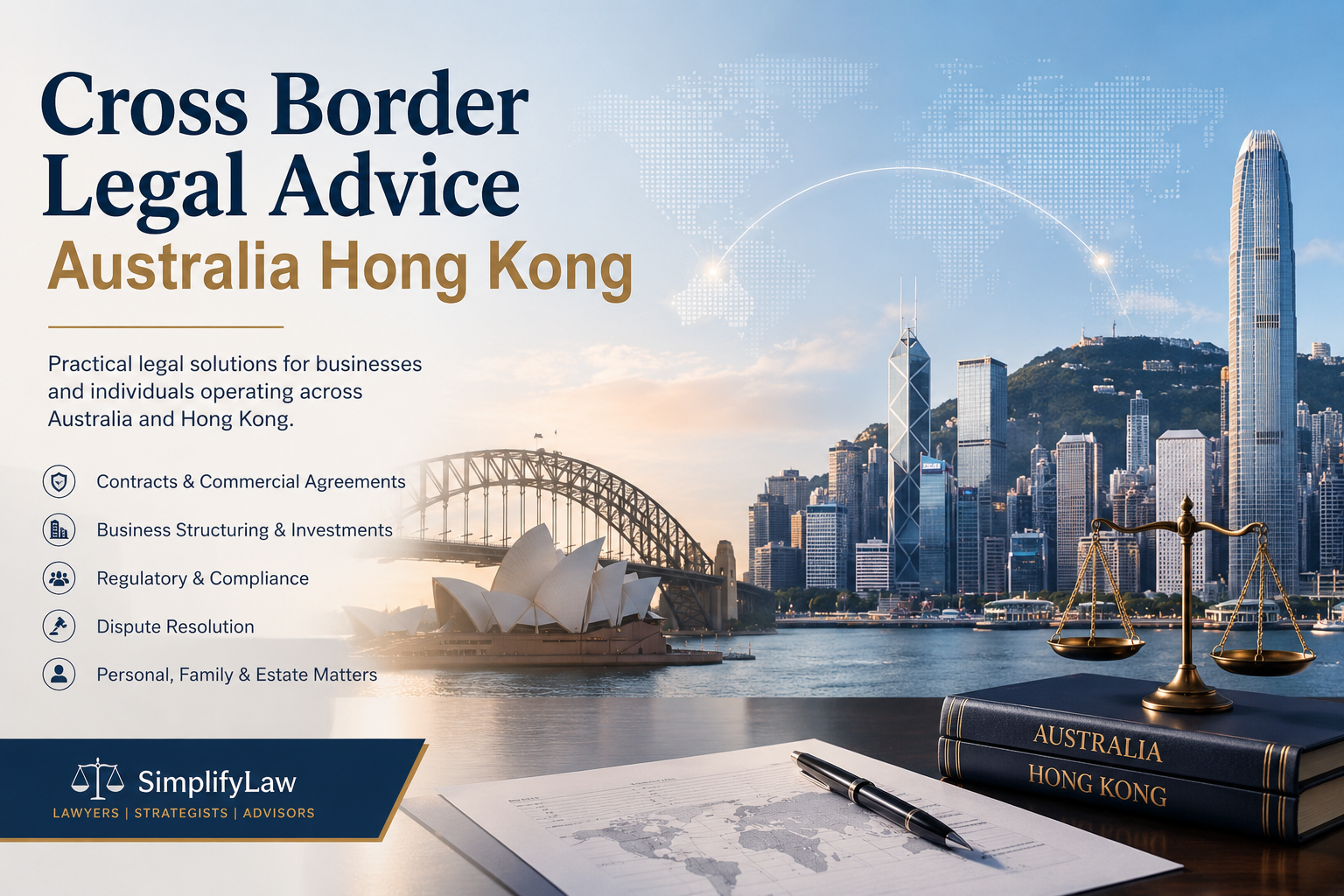
A contract can look settled on paper and still create real exposure once money, goods, staff, data or founders are spread across more than one country. That is usually the point where a cross border contract lawyer Australia businesses rely on becomes less of a nice-to-have and more of a practical risk control. The issue is rarely just the wording of a clause. It is whether the contract will work when different legal systems, languages, commercial norms and enforcement realities meet.
For Australian businesses dealing with Hong Kong or Mainland China, that gap between what a contract says and what it actually achieves can be significant. A supplier agreement, distribution arrangement, services contract, joint venture document or shareholder agreement may appear familiar at first glance. But once you test governing law, dispute resolution, payment mechanics, intellectual property ownership, local regulatory requirements and bilingual interpretation, the details matter quickly.
What a cross border contract lawyer in Australia actually helps with
A good cross-border contract lawyer does more than mark up clauses. The real value is in structuring an arrangement that reflects how the deal will operate in practice and where pressure points are likely to arise.
That starts with the basics. Which entity is signing? Is the counterparty the company with assets, or merely an affiliate with a similar name? Are there guarantees, parent company support or security protections where needed? In cross-border matters, a contract is only as useful as the party standing behind it.
From there, the focus shifts to legal alignment. Australian parties often assume a familiar common law approach will carry across neatly. Sometimes it does. Sometimes it does not. Hong Kong may feel commercially familiar in many transactions, while Mainland China can require closer attention to local law, enforceability, execution formalities and practical dispute pathways. Even where the legal concepts overlap, the business expectations around performance, variations, acceptance, timelines and relationship management may differ.
This is where commercially minded legal advice matters. The question is not whether a contract is technically comprehensive. It is whether it is clear enough to support the relationship and strong enough to protect you when the relationship changes.
Why cross-border contracts fail even when they look well drafted
Many contract problems are not caused by missing boilerplate. They come from assumptions.
One common assumption is that governing law solves everything. It helps, but it is only one part of the picture. If your contract says New South Wales law applies, that does not automatically make enforcement straightforward against a party, asset or witness located elsewhere. A judgment or award still needs a practical path to recognition and enforcement.
Another assumption is that a bilingual contract is simply a translation exercise. It is not. If the English and Chinese versions differ, which version prevails? Are key commercial terms translated consistently? Does the translated wording reflect legal intent, or just literal wording? A poorly handled bilingual contract can create uncertainty on the exact point it was meant to clarify.
There is also the issue of commercial culture. In some cross-border transactions, parties move quickly on broad commercial principles and expect detail to be resolved during performance. In others, written specificity is treated as essential from the outset. Neither approach is inherently wrong, but mismatch creates friction. A contract that ignores those operating realities may be legally polished and still commercially clumsy.
Key clauses a cross border contract lawyer Australia clients should review closely
Some clauses deserve more attention in cross-border agreements because they shape what happens when things go well and when they do not.
Governing law and jurisdiction are obvious starting points, but they should be considered together with dispute resolution. Court litigation may suit some matters. Arbitration may be more useful where parties, evidence and enforcement sit across multiple jurisdictions. There is no universal answer. The right choice depends on the parties, the nature of the deal, urgency, confidentiality concerns and where enforcement may be needed.
Payment terms also need closer scrutiny than many parties expect. Currency, exchange risk, tax treatment, invoicing requirements, withholding obligations and cross-border transfer logistics should be dealt with expressly. Vague payment drafting is often tolerated in domestic deals and regretted in international ones.
Intellectual property is another frequent problem area. If an Australian company engages an overseas developer, manufacturer, consultant or agent, who owns the output? Is the assignment valid in the relevant jurisdiction? Are there restrictions on use, sublicensing or registration? If confidential know-how is central to the deal, confidentiality language must match the commercial reality of who will access it and where.
Termination rights should also be practical, not merely legalistic. If the relationship deteriorates, can you stop supply, transition customers, recover data, secure tooling, retrieve stock or preserve brand control? In cross-border contracts, the clean legal right to terminate may be less useful than a carefully planned exit framework.
Australia, Hong Kong and Mainland China: where the differences matter
For businesses working across Australia, Hong Kong and Mainland China, the challenge is often not just legal difference but legal and commercial interaction.
Australia usually brings a direct preference for clear drafting, defined risk allocation and documented compliance. Hong Kong often works comfortably within sophisticated international contracting practice while also reflecting regional commercial expectations and speed. Mainland China may require more deliberate attention to local legal requirements, documentary formality, regulatory overlays and the practicalities of dispute handling on the ground.
That does not mean one system is simpler or harder across the board. It means the contract strategy should match the jurisdictions involved. A founder entering a distribution arrangement with a Hong Kong counterparty who sources through Mainland China may need one set of protections. A family office investing across Australia and Hong Kong may need another. A manufacturing business moving from a trial supply arrangement to an exclusive long-term contract may need a more staged approach again.
This is where bilingual capability and cultural fluency have real commercial value. They help reduce misunderstanding early, not just solve it later. A lawyer who can identify where language, negotiation style or document structure may create avoidable risk is often protecting far more than the legal position.
When you need contract support early, not after the dispute starts
Many businesses only seek legal review when the other side sends a long-form contract or when the relationship is already strained. That is understandable, but it is rarely the most efficient point to engage counsel.
Early support is useful when you are entering a new market, appointing an overseas distributor, taking on an offshore supplier, licensing technology, hiring cross-border contractors, investing with offshore partners or negotiating with parties who use different language versions of the same document. These are all moments where structure matters more than reaction.
The same applies to growing businesses without an in-house legal team. A fractional general counsel model can make sense where contracts arise regularly and management wants consistency without carrying full-time overhead. Matter-based support may be more suitable for one-off transactions, negotiations or disputes. The right model depends on volume, complexity and internal capability.
What to look for in a cross-border contract lawyer
Technical contract skills are only part of the picture. You need someone who can translate legal risk into commercial decisions.
That means asking practical questions. Can they advise across the jurisdictions that matter to your deal, or coordinate effectively where local input is required? Do they understand how Australian businesses negotiate and operate? Can they work comfortably with Hong Kong and Chinese counterparties, including bilingual documents and cross-cultural communication? Will they tell you where to compromise and where not to?
The best advice is usually clear, calm and commercially grounded. It should help you move a deal forward with confidence, not bury you in unnecessary complexity. For clients dealing across Australia, Hong Kong and Mainland China, that combination of legal clarity and regional understanding is often what prevents small drafting issues from becoming expensive business problems later.
SimplifyLaw is built around that practical approach. The aim is not to make cross-border contracting sound more complicated than it is. It is to make sure the contract actually supports the outcome you are trying to achieve.
If a deal crosses borders, the legal work should do more than record agreement. It should help the agreement hold up when pressure arrives.