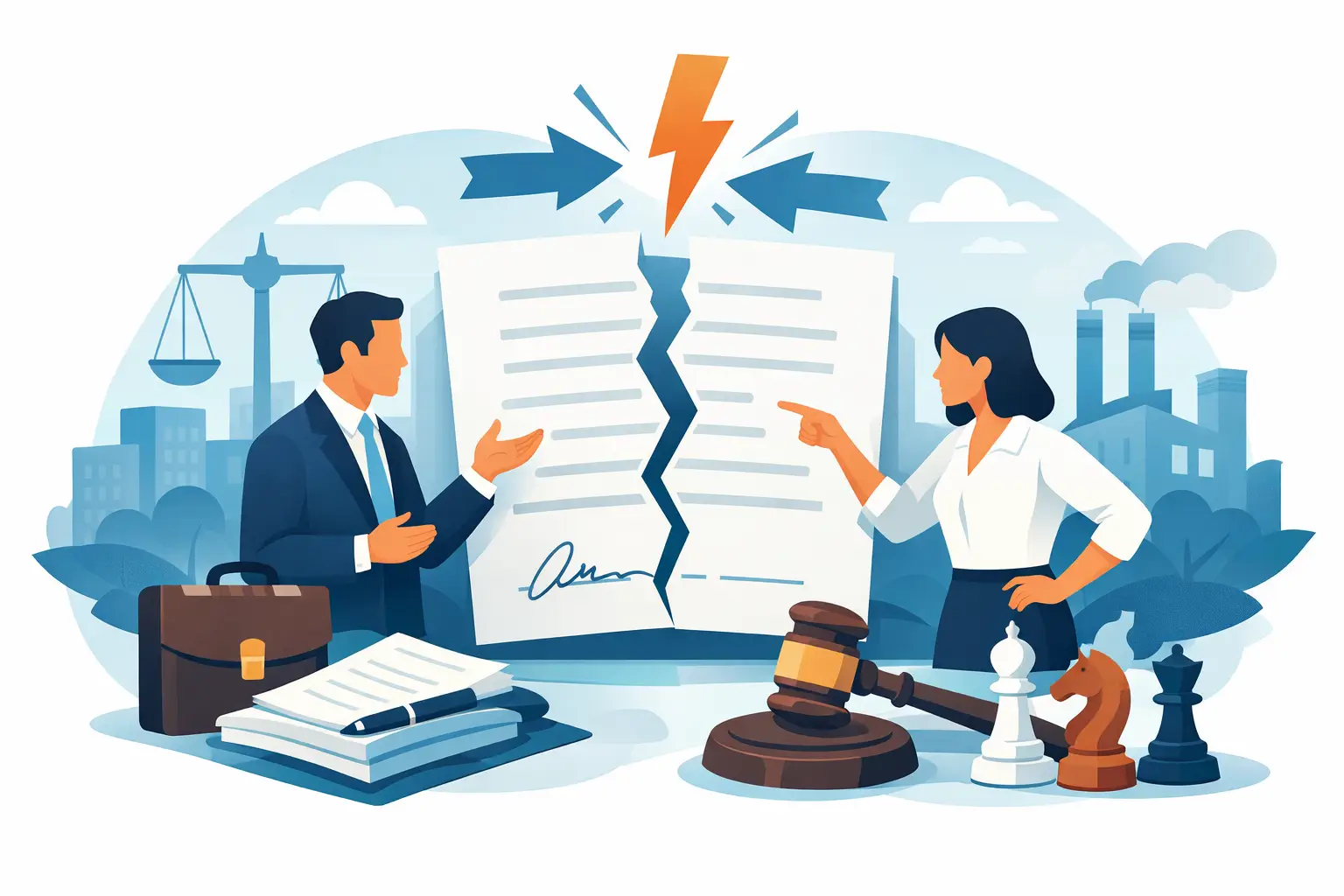
A missed payment, an unfinished project or a supplier who insists the agreed scope has changed can quickly become a commercial contract dispute. The legal question matters, but the first business question is often more urgent: what needs to happen now to protect cash flow, operations and the commercial relationship?
For Australian businesses, delay can make a manageable disagreement more expensive and harder to resolve. Documents disappear, positions become entrenched and an unguarded email can create avoidable difficulty. A measured early response gives decision-makers more options, whether the best outcome is a negotiated solution, formal recovery action or a clean exit from the arrangement.
Start with the contract, not the frustration
Commercial disagreements often begin with a reasonable sense that the other party has not done what it promised. That is not always the same as a legal breach. The contract may contain a notice process, a limitation of liability, a cure period or a dispute resolution clause that changes what can be done next.
Read the signed agreement together with its schedules, variations, purchase orders and any documents incorporated by reference. It is common for the commercial team to work from an earlier proposal while the legal position is governed by a later agreement. The detail matters: a statement that appears to be a firm commitment may be subject to a condition, approval or excluded service.
The immediate task is to establish four points: what each party was required to do, when it was required, what has actually occurred, and what the contract says should follow. This creates a clearer foundation for internal decisions and external communications.
Check whether a valid notice is required
Many contracts require notices to be given in a particular form, to a specified address or email address, and within a set time. A casual email to an account manager may not satisfy those requirements. Equally, a contract may require the parties to meet, escalate the issue to senior representatives or attempt mediation before commencing proceedings.
Notice provisions can feel procedural when a business is facing a pressing operational problem. They can nevertheless affect rights to terminate, claim damages or commence a formal process. Following them carefully is usually a low-cost way to preserve leverage.
Preserve the evidence while it is available
The strongest account of a dispute is supported by contemporaneous records, not reconstructed months later. Keep the signed contract and all versions, correspondence, meeting notes, invoices, delivery records, project plans and records of calls. Preserve relevant messages from platforms used to run the project, particularly where scope changes or approvals were discussed informally.
Create a short chronology that records dates, key events, amounts involved and outstanding actions. It should distinguish known facts from assumptions. This practical document can save substantial time when management, insurers, accountants or legal advisers need to assess the position.
Avoid making the position worse
A frustrated response can accidentally concede a point, waive a right or imply acceptance of a variation. Statements such as “we will sort it out later” or “we accept the delay” may carry more weight than intended in the context of the wider correspondence.
Businesses should also be cautious before stopping performance, withholding payment or terminating a contract. Those steps may be justified, but if taken without a contractual or legal basis they can expose the business to a counterclaim. The right response depends on the terms, the nature of the breach and the governing law.
What commercial contract disputes are really about
The label “contract dispute” covers many different problems. Identifying the real issue prevents the discussion from becoming an argument about every past frustration in the relationship. Common issues include:
- non-payment, disputed invoices or disputed set-offs;
- delayed delivery, defective goods or incomplete services;
- scope changes, variation claims and unclear acceptance criteria;
- termination rights, renewal arrangements and restraint obligations; and
- confidentiality, intellectual property or misuse of business information.
More than one issue may be present, but one will usually drive the commercial outcome. A business waiting on a significant receivable may need a prompt payment solution. A company dealing with defective work may need replacement performance, not a damages claim that takes years to resolve. Where confidential information is at risk, immediate protective action may matter more than the final value of a claim.
Quantifying the exposure is equally important. Consider unpaid sums, the cost to rectify or replace performance, lost revenue, internal management time and the effect on customers or supply chains. A claim with a strong legal basis may still be unsuitable for prolonged litigation if recovery is uncertain or the other party has limited assets.
Choose a resolution path that serves the business
The best process is not always the most aggressive one. Direct commercial negotiation can resolve a matter quickly where both parties want to preserve the relationship and the facts are reasonably clear. A focused letter setting out the contractual position, the requested remedy and a realistic deadline often brings discussions to a more productive level.
Mediation can be useful where there is a meaningful dispute about facts, performance or valuation, especially if the parties need to continue dealing with each other. It gives each side greater control over the outcome than a court judgment and can accommodate practical solutions, such as revised delivery milestones, staged payments or a mutual release.
Arbitration may be required by the contract, particularly in international arrangements. It can offer privacy and a process suited to cross-border enforcement, but it is not automatically cheaper or faster than court proceedings. The arbitration clause, governing law, seat of arbitration and likely enforcement location should be considered before a dispute arises, not only after it has escalated.
Court proceedings may be appropriate where a party refuses to engage, urgent orders are needed, or a formal judgment is necessary to enforce a clear debt. Proceedings can also create useful pressure, but they involve cost, time and management attention. Sound advice should explain both the legal prospects and the commercial trade-offs.
Cross-border commercial contract disputes require extra care
A dispute involving Australia, Hong Kong or Mainland China adds questions that cannot be answered by looking only at the invoice or the signed agreement. Which law governs the contract? Where must a claim be brought? Is an Australian judgment likely to be enforceable where the counterparty’s assets are located? Which language version of the contract prevails if there is an inconsistency?
Cultural and operational context can also affect how a dispute should be approached. In some business settings, preserving a relationship and allowing senior representatives to address the issue privately may produce a better result than an immediate confrontational demand. That does not mean compromising legal rights. It means choosing a process and communication style that supports the desired outcome.
Bilingual documents and communications need particular scrutiny. A translated clause may not carry precisely the same legal or commercial meaning as the original. Businesses should avoid assuming that an English-language summary reflects the operative Chinese-language agreement, or vice versa. Early review by advisers familiar with the relevant jurisdictions can identify jurisdictional gaps before they become expensive obstacles.
Build dispute readiness into everyday contract management
Most disputes are easier to handle when the business has a disciplined contract process before anything goes wrong. Keep signed agreements in one accessible location, record renewals and notice dates, and ensure staff know who can approve changes to scope, price or delivery. Informal operational changes are often necessary, but they should be documented in a way that is consistent with the contract.
For businesses with regular supplier, customer or cross-border arrangements, ongoing legal oversight can be more useful than seeking advice only after a dispute has hardened. A fractional general counsel model can help management identify recurring risk, improve contract templates and create escalation processes suited to the business.
That preparation is not about turning ordinary commercial conversations into legal exercises. It is about giving the business a reliable record and clear decision-making framework when money, performance or reputation is at stake.
When early legal advice makes the difference
Legal advice is particularly valuable before issuing a termination notice, responding to an allegation of breach, accepting a settlement proposal or commencing debt recovery. These are points at which a poorly framed response can narrow options. Early advice can also help a business decide whether the matter warrants formal action at all.
SimplifyLaw helps clients assess disputes with both the legal position and the commercial objective in view, including matters that touch Australia, Hong Kong and Mainland China. Clear advice should leave decision-makers knowing what they can do, what they should avoid and what the likely cost of each path may be.
The practical aim is not to win every argument on paper. It is to make a timely, informed decision that protects the business and leaves it able to move forward.